We are a team of university and community-based researchers mapping the political and organizational ecosystems that Latinx and Latinx immigrant communities create to explain how racialized communities forge collectives to achieve their goals amid exclusive and repressive environments across the United States, and how they have done so across time and place.
Knowing that students are capable knowledge producers, this research was developed with cohorts of undergraduate and graduate student researchers with the goal of nurturing and investing in Latinx researchers. Knowing that community-based leaders and advocates have political and policy expertise, our research team worked with movement organizers, community advocates, and capacity builders with decades of experience to shape all facets of our social science project – from developing an ethical data collection protocol to developing new questions to developing a communication of results plan that is accessible to academics and publics alike. In doing so, we co-developed a project and a research process with the intent of contributing to both political science debates while also supporting on-the-ground investments for organizations.
I. Contributing to the Study of U.S. Latinx Politics: Studying the Organizational Terrain of Latino Political Life
In our Latinx Organizational Archives (LXOA) Project, we center Latinx communities across the United States (L), take seriously the “X” in Latinx by dedicating theoretical and empirical attention to intra-group inequalities (X), move the scope of analysis from mass-level behavior to organizational-level behavior (O), and we go beyond current political science standards to create replicable data to also archive the work of organizations as part of a larger effort to create more accurate accounts about the political lives, collective action, and influence of Latinos across the United States (A).
Through a data-generating process informed by the political conditions of U.S.-based Latinos, we created a database of 700 organizations that serve, represent, or lobby on behalf of Latinx and Latinx immigrant communities across the United States. We draw on publicly available materials, including websites, reports, videos, and social media, to examine the work of organizations working across a range of issues (from education to immigration, from policing to housing, and from environment to health) and across levels (local, state, national, transnational).
By centering Latinx-serving organizations and Latinx organized interests, we are revisiting questions about civic infrastructure in an era of democratic erosion, intra-group representation inequalities, organizational emergence and adaptations, and the behavior and strategies of minority-serving interest groups.


II. Building Inclusive Systems of Knowledge Production: Training Cohorts of Students
This research was developed with cohorts of undergraduate and graduate student researchers at Arizona State University and is ongoing.
Students received training and mentorship from Dr. Angie Bautista-Chavez, Dulce Juarez, Andrea Whiting, and Victoria Villalba as we collectively designed the LXOA Project—from conceptual development to database building, from developing a codebook and coding theoretically informed variables to manuscript writing and presenting at academic conferences.
The first team of researchers conducted case studies of organizations for the conceptual development of “Latinx-serving organizations.” This team received course credit and included Emiliano Galvan, Citlaly Gomez Ibarra, and Ronaldo Moreno.
The second team participated in a research ethics workshop and began developing a 50-state inventory of Latinx-serving organizations. This team received course credit and included: Abril Valenzuela, Rosa Aguirre Gutierrez, Jarizbeth Caballero, Kaitlyn Navarrette, Marlene Marquez, Danna Lopez, Julie Andres, Dayne Saldana, and Ricardo Romero.
The third team of researchers expanded the database using automated text analysis tools and a theoretically informed codebook to code for organization-level variables. This team worked as Research Assistants and included Jordin Tafoya, Jarizbeth Caballero, Kaitlyn Navarrette, Julie Andres, Dayne Saldana, and Ricardo Romero.
The current team includes Jordin Tafoya, Kaitlyn Navarrette, Dayne Saldana, Julie Andres, and Jarizbeth Caballero. Tafoya is an expert in quantitative data analysis, and her substantive interests include the politics of representation and representational inequalities. Saldana draws on their work as a community organizer, and their substantive interests include organizational leadership. Navarrette’s substantive interests include the relationship between policy, communities, and organizations.
This research project has received institutional support from ASU’s Center for Latinas/os and American Politics Research (CLAPR) and UCLA’s Latino Policy & Politics Institute (LPPI).

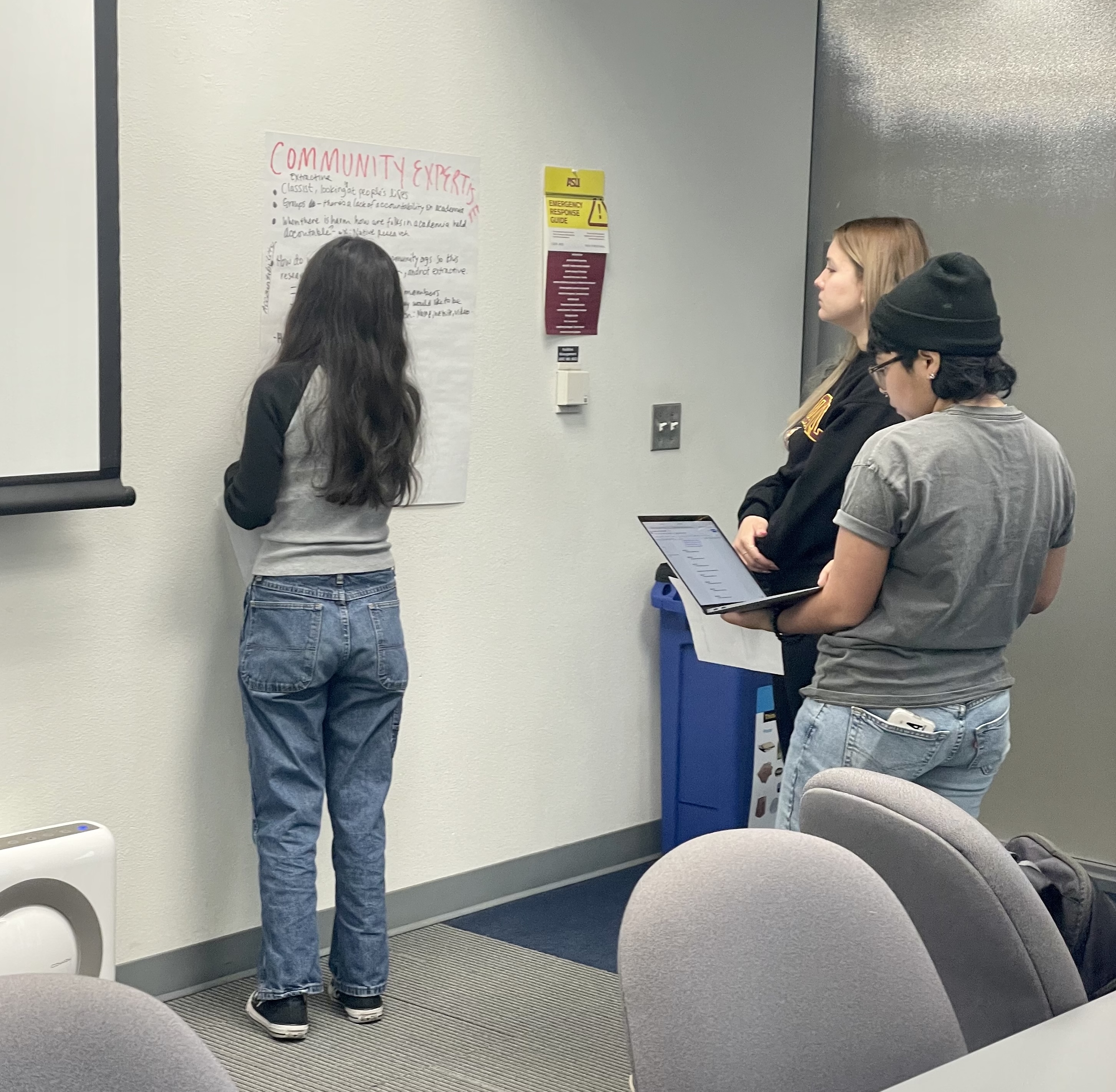
III. Sharing Research Power: Inviting Community-Based Leaders into the Research Design Process
This is a civically engaged research project. Across 2023 and 2024, our research team worked with three community-based leaders with decades of change-making experience to develop an ethical research design, a data collection protocol, and a plan for communicating results.
Dulce Juarez, Andrea Whiting, Victoria Villalba, and Dr. Angie Bautista-Chavez formalized their collaboration through a “Community Research Consultant Process,” whereby community-based leaders intervene in social science research protocols.
Through a series of workshops and meetings, our team received the following Reciprocity Mandates from our community partners:
- Produce research to preserve the work of community-based organizations – especially those organizations that get written out of the historical record.
- Produce research to credit the work of community-based organizations – especially those whose work may receive less visibility or less recognition.
- Provide accurate descriptions of the work by community-based organizations – this requires centering the perspectives of organizations, their leaders, their members, and the political ecosystems they navigate.
- Produce research accessible to the communities we are studying – this includes writing reports for the public.
- Mobilize research and data for the redistribution of resources – this includes motivating additional investments and support for organizations working on the ground year-round.
IV. Mobilizing Data for the Re-Distribution of Resources
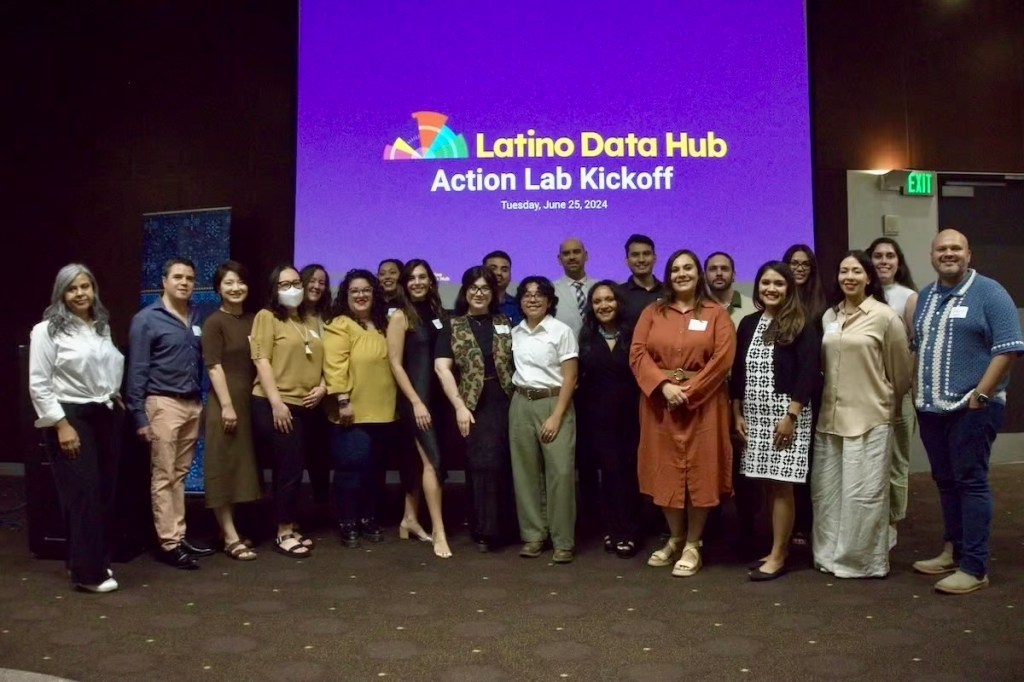
Our team partnered with ASU’s Center for Latinos/as and American Politics Research and UCLA’s Latino Policy & Politics Institute to develop and implement the Inaugural Latino Data Hub Action Lab in Phoenix, Arizona.
To support the development of the Latino Data Hub Action Lab, we prepared an internal report that highlights organizations and leaders who work year-round to serve and advocate for Latinx and Latinx, immigrant, and marginalized communities across Arizona.
V: Our Research Pipeline
Revise and Resubmit: “Community-Based Leaders and Civically Engaged Research: Lessons from the Remaking of the Latinx Organizational Archives Project” (Angie Bautista-Chavez, Dulce Juarez, Andrea Whiting, and Victoria Villalba)
Submitted Book Chapter: “Building a Database of Latino Organizations as Method” (Angie Bautista-Chavez, Jordin Tafoya, Kaitlyn Navarrette, Dayne Saldana, Jarizbeth Caballero, and Julia Andres) >> For Edited Volume, Latinx Methods and the Politics of Praxis with Duke University Press (Co-Editors: Thomas Conners and Maia Gil’Adí)
Working Paper: “The Organizational Terrain of U.S. Latinx Politics: Mapping Theoretical and Empirical Pathways” (Angie Bautista-Chavez, Jordin Tafoya, Ricardo Romero, Kaitlyn Navarrette, Dayne Saldana, Jarizbeth Caballero, and Julia Andres)
Best Paper Award: “Revisiting Representation and the Role of Latino Intermediaries: Intersectional Constituencies and Place-Based Politics” (with Jordin Tafoya, Kaitlyn Navarrette, and Dayne Saldana) >> Winner of the 2024 Western Political Science Association’s Latina/Latino Politics Best Paper Award
Internal Report: “The Latino Civic Ecosystem at Work in Arizona: Past, Present, and Future Trajectories” (with Jordin Tafoya, Dayne Saldana, Kaitlyn Navarrette, Jarizbeth Caballero, Julia Andres) >> December 2023 Report for the UCLA Latino Policy & Politics Institute and the JP Morgan Chase & Co Grant
Internal Report: “Centering Latinx Organizations and Leaders Without Reproducing Erasure, Harm, and Extraction” (with Rosa Aguirre Gutierrez, Julie Andres, Jarizbeth Caballero, Danna Lopez, Kaitlyn Navarrette, Marlene Marquez, Dayne Saldaña, Abril Valenzuela, Richie Romero, Dulce Juarez)
 Angie M. Bautista-Chavez