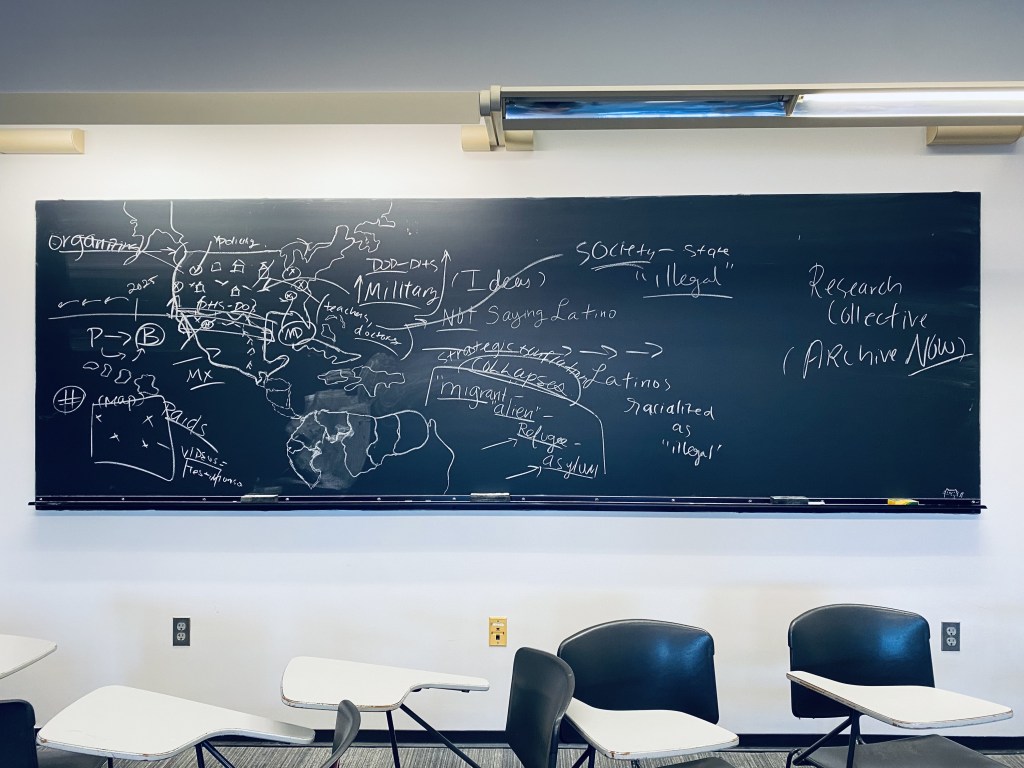
“This is an intense course that will make students really think about current events and their historical roots. I remember calling in to federal court proceedings of Guatemalan children who were almost deported. It made the real-world implications of everything we were learning so vivid and tangible. I appreciated that the professor exposed us to these realities and did not just describe what we were learning in the abstract.”
– Anonymous Student, Fall 2025 Course Evaluations
Spring 2025: “Latinos and the American Political Landscape”
In Spring 2025, the theme of my APD course was: “Latinos and the American Political Landscape: Revisiting APD Through the Experiences of Latinos across Time and Place.”
My Latino APD class revisits some of the APD’s biggest questions through the experiences of Latinos across the United States. The class progresses in four stages: I: Retool, II: Recover, III: Revisit, and IV: Research.
By the end of the course, students will be able to engage with and answer some of the most pressing questions about the relationship between Latinos and American political development.
- How did American state building, American racial capitalism, and American empire create a varied set of racialized citizenship regimes that shaped the legality and membership of Latinos, and how are these related to domestic racial hierarchies and international projects?
- What do the lives of Latinos tell us about the entanglements between the American welfare state, the American migration state, the American carceral state, and the American settler imperial state?
- How did the regulation of Latino immigrants and asylum seekers from Latin America and the Caribbean serve as an engine for the American administrative state – including the making of border bureaucracies, networked policing that harnesses the institution of federalism, and the development of ocean-spanning detention infrastructure?
- How did Latinos become racialized as ‘illegals’ and the prime targets of state action? How have these state efforts led to a varied set of processes and effects – at once suppressing Latino political agency, mobilizing Latino collective action, and even conscripting Latinos into the enforcement apparatus?
- How do groups of Latinos – in relation with and to, and in coalition with Black, Indigenous, and Asian organizing – cultivate and assert political and policy influence in the face of compounding crises, including climate change, policing, detention, and gentrification, all while navigating institutional constraints?
- How do those most marginalized among the Latino population – including Black, Trans, Queer, Immigrant, and Undocumented Latinos – contend with intra-group and inter-group hierarchies, and what do their movements tell us about the promise and possibilities of large-scale political transformations?
Topics by Week
Part I: Retool
- Week 1 – Latinos and American Political Development
- Week 2 – Time and Policy Feedback
Part II: Recover
- Week 3 – “The Latino Threat” and Racialized Illegality
- Week 4 – The Entangled Welfare State, Carceral State, and Deportation State
- Week 5 – Detention and American Empire
- Week 6 – Restorative Methods: Theory and Practice
- Week 7 – Racial Capitalism and Colonial Relations of Power
- Week 8 – Technologies of Control
- Week 9 – Spring Break
- Week 10 – Threat, Mass Mobilizations, and Containment
Part III: Revisit
- Week 11 – Racial Orders and Hierarchies
- Week 12 – Expansion and Mass Removals
- Week 13 – Social Movements and State Institutions
- Week 14 – In Class Research Conference
>> Download Spring 2025 Description
Fall 2025: “The Violence of Path Dependence and the Power of Path-Makers”
The theme of my Fall 2025 APD Course is: “The Violence of Path Dependence and the Power of Path-Makers.” The course draws on relational frameworks and restorative methodologies.
Topics by Week
- Week 1: The Political Violence of Path Dependence
- Week 2: Citizenship: A View from the Territories
- Guest Lecture by Dr. Maye Henning
- Week 3: The Not Weak American State: Lynching and Expulsions
- Week 4: Weapons of the State: Criminalization and Surveillance
- Week 5: State Power, Data, and Archives, I
- Week 6: Deportations and Weapons of Mass Dis-Organization
- Week 7: Nation-State Border-Making Technologies
- Week 8: Land and Place as Method
- Guest Lecture by Dr. Elise Blasingame
- Week 9: People Power, Data, and Archives, I
- Week 10: Disciplining Movements
- Week 11: Relational Deviance
- Guest Lecture by Dr. Kaneesha Johnson
- Week 12: People Power, Data, and Archives, II
- Week 13: Hemispheric Rebellions and Alternative Paths
- Week 14: In-Class Research Conference
 Angie M. Bautista-Chavez